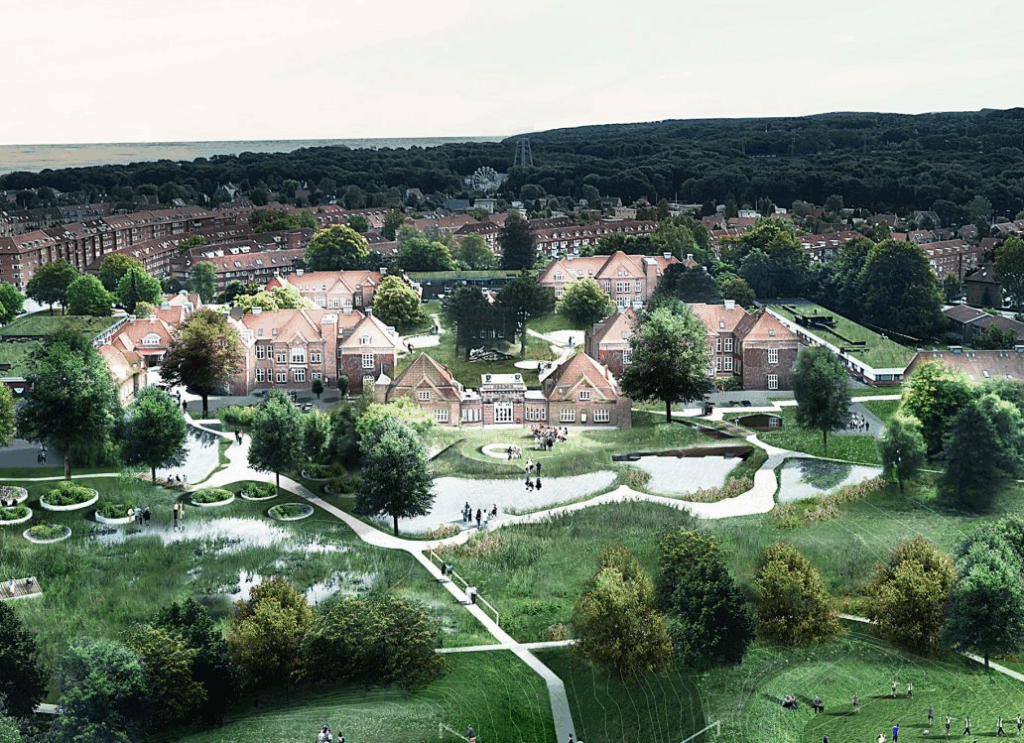
Picture this: a small hill with a rehabilitation centre on top, surrounded by low-lying land that floods every time there is heavy rain. Aarhus, like the whole of Denmark, has an unpredictable climate: rainfall can be short and gentle, or sudden and destructive. This feature of the landscape is the main reason SPARK was created – the world’s first park that not only cleans stormwater but also improves the quality of local people’s lives. In this article we look at how the project’s developers turned a 100-year-old hospital into a new and attractive place that became at once an example of climate adaptation and a space for patients’ active recreation.
How the idea came about
In the very heart of Aarhus lies the Marselisborg rehabilitation centre – a place where patients have recovered their health for decades. Its particular geographical position on a hill was both an advantage and a challenge: the low-lying areas around it regularly suffered from flooding.
This problem was the starting point for the idea. The project’s developers had an ambitious goal: to transform the area around the centre into a modern, multifunctional space combining nature, urban infrastructure and green technologies.
The core idea of the project was to create a climate-adapted environment that would protect both the building and the city from flooding, support biodiversity and foster an atmosphere for social interaction.
Delivering the project
By combining innovative technologies with a thoughtful approach, the team managed to create a truly balanced “ecosystem” in the middle of the city, on a site of more than 40,000 m². Thanks to a carefully designed drainage system, the park not only serves as an effective barrier against floods but is also an important place for recreation, cultural events and rehabilitation. The developers also used bioengineered filters and special water-retention structures combined with natural ponds. These allow the park to absorb and drain excess rainwater effectively, greatly reducing the risk of flooding, protecting urban infrastructure and preventing frequent downpours from disrupting residents’ comfort.
The developers also set out to create a space for city dwellers where people could spend their time in a meaningful way.
For patients of specialised centres, new conditions were created for physical and psychological recovery. What makes SPARK unique is that it is the world’s first urban park designed from the outset with climate change adaptation, social integration and nature conservation in mind.
Bringing such a vision to life was not only an important step in the development of urban space in Aarhus, but also a model for other cities that want to create comfort and cosiness for their residents while caring for nature.
Funding
According to the available data, the project received €4.7 million in funding thanks to support from various parties: the rehabilitation centre, the Central Denmark Region, the Municipality of Aarhus and the company Aarhus Vand, which together invested €2.7 million.
Results
The SPARK project is a striking example of how ecological innovation and social initiatives can be combined not only to improve the environment but also to strengthen health and social integration.
The park that was created had a positive impact on the rehabilitation centre’s patients and on the state of nature.
Every year, more than 2,500 outdoor rehabilitation courses help improve the physical and psychological health of roughly 15,000 people, thanks to the creation of spaces in the park that help staff organise a variety of activities for patients.
One of the project’s main achievements is the integration of people into environmental initiatives: in 2017, more than 900 people from local institutions took part in project activities, demonstrating the success of combining social reintegration with environmental measures. Thanks to the park’s large area, it is possible to create activities for different population groups that promote not only physical health and social integration but also public awareness of the importance of adapting to climate change.
This project also plays an important role in adapting to climate change, in particular in protecting the city from flooding. The park’s effective design helps reduce the load on local drainage systems, which is becoming critically important under a changing climate. It is a significant step towards the city’s sustainable development, since projects like this make the area more resilient to increasingly common natural disasters. SPARK also brings considerable economic benefits, such as higher employment in the environmental sector. Expanding green space not only improves air quality but also has a positive effect on preserving biodiversity and contributes to an overall improvement of the city’s ecological situation. The project also had a socio-cultural impact, in particular on the health and well-being of the local population. And a final benefit, no less important – the increased interest in education and research in the field of ecology, which will help develop society and shape a new generation that takes a more responsible attitude towards protecting the environment.
The SPARK project has become a true symbol of harmony between people and nature. It opened a new era of urban development in which ecological resilience, social responsibility and a comfortable environment become inseparable parts of life. It is more than a park – it is a space of opportunity that inspires, strengthens health and unites society for a shared future, one in which everyone can spend time enjoying clean air, nature and a sense of home.